- the WSES and CWIS position paper_page-0001_thumbnail.jpg)






_thumbnail.jpg)
_thumbnail.jpg)

_thumbnail.jpg)
_thumbnail.jpg)
_thumbnail.jpg)


_thumbnail.png)
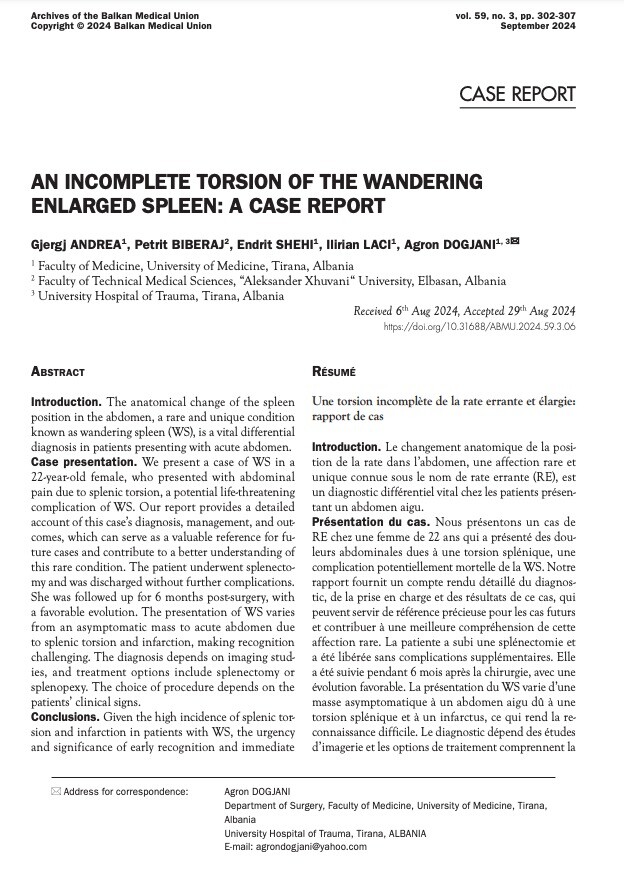
An Incomplete Torsion of the Wandering Enlarged Spleen. A Case Report.
- Agron
- Published Articles
- Hits: 423
User Rating: 5 / 5

Abstract
Introduction: Anatomical changes in the spleen's position in the abdomen, a rare and unique condition known as wandering spleen (WS), are a vital differential diagnosis in patients presenting with an acute abdomen.
Case presentation: We present a case of WS in a 22-year-old female who presented with abdominal pain due to splenic torsion, a potentially life-threatening complication of WS. Our report provides a detailed account of this case's diagnosis, management, and outcomes, serving as a valuable reference for future cases and contributing to a better understanding of this rare condition.
The patient underwent splenectomy and was discharged without further complications. She was followed up for 6 months post-surgery, with a favorable evolution.
The presentation of WS varies from an asymptomatic mass to an acute abdomen due to splenic torsion and infarction, making recognition challenging. The diagnosis depends on imaging studies, and treatment options include splenectomy or splenopexy. The choice of procedure depends on the patient's clinical signs.
Conclusions: Given the high incidence of splenic torsion and infarction in patients with WS, the urgency and significance of early recognition and immediate intervention cannot be overstated. Surgery is the gold standard treatment, with both splenopexy and splenectomy being effective and safe options.
Keywords: wandering spleen, splenectomy, splenic torsion.
Infectious Disease Specialists, trauma, and surgery
- the WSES and CWIS position paper_page-0001.jpg)